

In a previous post, we covered the results that Chairwoman Namba Tomoko presented at AI Day 2026. 20x productivity, 90% reduction in legal costs, the efficiency paradox. The numbers were impressive. But what does it look like on the ground? We asked Developer A, who works at DeNA, directly.
#”We’re Cutting Headcount in Half” — The Line That Landed on the Floor
In June 2024, at a company-wide meeting, someone said “the goal is to cut headcount in half.” Dropped without context, the internal chat lit up immediately. “Are they going to fire us?” was the overwhelming reaction.
The explanation came later. The idea was to do the current workload with half the people, and have the rest go find new AI-driven business opportunities. The target timeline was roughly two years. In practice, it meant each person needed to use AI to do the work of two or more.
#DARS — Measuring AI Proficiency
Starting in August 2025, DeNA rolled out DARS (DeNA AI Readiness Score) company-wide. It measures AI proficiency on a five-level scale, with separate tracks for non-developers (business, creative, management) and developers. For non-developers, the bar is “can you refine and use AI output?” For developers, it’s “can you design and operate AI agents?” Even at the same level, the required competencies differ.
#Individual Levels (Developer Track)
- Level 1: Can generate code and gather information through conversation with AI
- Level 2: Can integrate AI into an editor and improve prompts
- Level 3: Can use agents to replace parts of a workflow and design prompt chains
- Level 4: Can operate standalone agents as team members and design AI apps/agents
- Level 5: Can build AI platforms and orchestration agents, and lead AI development across the organization
In addition to individual levels, there are separate organizational levels. Quantitative criteria like “50% or more of members at individual level 2 or above” make it possible to track AI adoption at the team level.
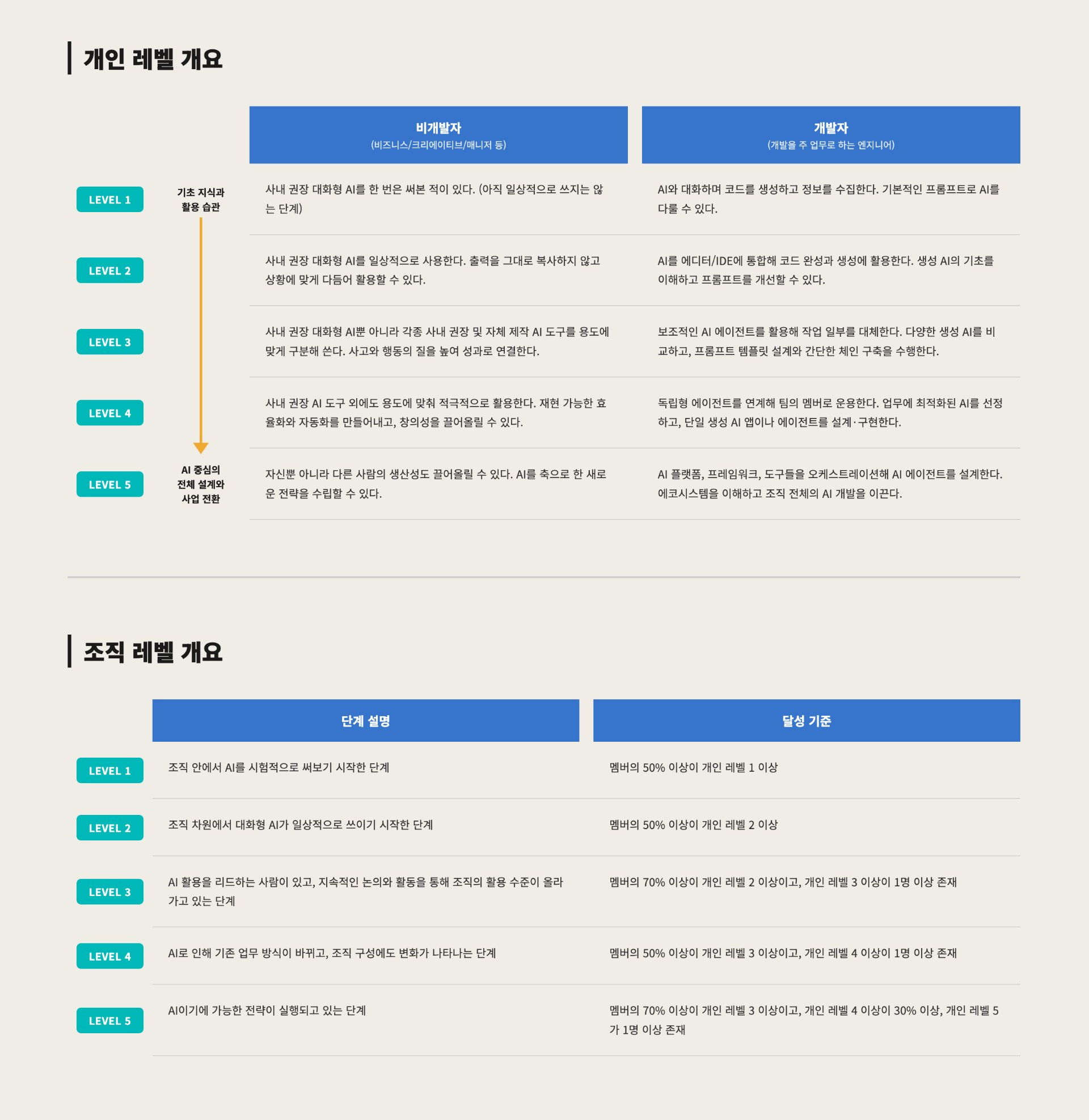
According to Developer A, most employees are stuck at Level 2, and no one has reached Level 4 or 5 yet. The company wants individuals to get to Level 4, but there’s still a long way to go.
DARS is not currently tied to performance reviews. However, the message that “it will be eventually” is being communicated loud and clear.
#The Reality of AI Costs — From Experimentation to Settling In
Right after the AI all-in declaration, DeNA headquarters covered all AI usage costs. Under a “use it as much as you want” policy, the entire company used the Vertex AI API. Since billing was per token, some individuals racked up over 1 million won (roughly $700) per month.
But as the experimentation phase wound down, the cost structure shifted. Starting April 2026, AI costs were transferred from headquarters to individual service organizations, and per-person spending limits were tightened accordingly. In exchange, the company purchased unlimited-use tools. Those tools are Devin, an autonomous coding agent that takes on tasks and independently plans, codes, and opens PRs, and CodeRabbit, a code review tool.
The era of testing every possibility has passed. Now it’s about locking in the right tools and cost efficiency.
#How Devin Changed the Development Landscape
Since Devin was introduced, there’s been one very visible change: GitHub PRs (Pull Requests) now have 200 comments on them. Before, developers worked locally, so the process was invisible. Now every conversation with Devin is recorded.
This cuts both ways. The upside is that the work process has become transparent. The flip side is that everyone can now see who did what and how much.
The development process itself has also changed. Before, teams would create mockups, get them reviewed, and then start building. Now “just build it” is the default. It’s faster to have AI whip something up and iterate than to polish a mockup.
#Different Teams, Different Speeds
Namba said “AI handles 95% on some projects.” The reality on the ground is different. For Developer A’s team, it’s roughly 40–50%. The 95% figure is an outlier — most teams fall closer to this range.
The type of team matters too. Teams that handle standardized common tasks — like security issues or infrastructure migrations — have higher AI adoption rates. Teams designing new features have lower rates. These teams spend their time first building good context to hand off to AI. They’re experiencing the second phase of AI adoption firsthand: Context Engineering.
Speed gaps between teams are growing. Some teams finish three-month plans in two weeks, while others struggle to fit within three months. The once-uniform development cadence is being reshuffled into different speeds for each team.
#New Graduate Hiring Frozen for Two Years
Since the AI all-in declaration, Developer A’s team hasn’t hired a single new graduate in two years. Once the “halve the headcount” message was out, aggressive hiring was off the table. When they do need to hire, it skews toward experienced engineers who can contribute immediately.
Developer A puts it this way: “When a company this size stops hiring new graduates, you have to wonder — where are Japan’s junior developers supposed to go?” AI boosts productivity, but the space for juniors to grow is shrinking. The question of who actually benefits from these efficiency gains remains unanswered.
#What the Trenches Are Really Saying
As with any major change, the numbers executives see and the temperature on the floor are different. The variance across teams is large, and there are still plenty of problems to solve.
Even so, the daily life of a developer has undeniably changed. The old sequence — design, get approval, then build — has been flipped. Now you build with AI first, then refine from there. Nobody works the same way they did a year ago.
The AI all-in is still in progress. But the point of no return has already passed.