

This post is based on my experience during the OKR hype. Many organizations have since reached similar conclusions, but I wanted to document what I observed firsthand.
#The Origin and Rise of OKRs
OKR (Objectives and Key Results) is a goal-setting methodology conceived by Andy Grove at Intel in the 1970s and formalized in his book High Output Management. The core idea is simple: “Where do I want to go? (Objective)” and “How will I know I’m getting there? (Key Results).” By grounding goals in measurable outcomes, it became a powerful tool for aligning an entire organization around a shared direction.
The real boom started in 1999. John Doerr introduced OKRs to Larry Page and Sergey Brin at the newly founded Google, and Google adopted them company-wide. LinkedIn, Twitter, Uber, Spotify, and others followed suit, establishing OKRs as the standard management methodology in Silicon Valley.
The turning point came with a 2012 workshop talk. Rick Klau, a partner at Google Ventures, gave a presentation introducing OKRs to startups. Once published, it surpassed 5 million views and became the OKR playbook for countless companies. In that talk, Klau explained that OKRs should be implemented at three levels — company, team, and individual — and many companies followed this blueprint to the letter.
#But Did Individual OKRs Actually Work?
Spotify’s Experience
Spotify decided to drop individual OKRs in 2013 and publicly explained their reasoning in a 2016 HR blog post.
“OKRs work well on a corporate level… But our corporate level is very nimble. So our objectives change fast and adapting iterated OKRs on multiple levels all the way to the individual consumed time and energy that we just couldn’t afford.”
There were three reasons. First, in a fast-moving organization, cascading OKRs down to the individual level was pure overhead with no payoff. Second, OKRs pushed people to focus on the “how,” when what Spotify needed was focus on the “why.” Third, in an environment where direction shifts frequently, the inputs to OKRs were already outdated by the time they were written. Shit in, shit out.
Google’s Self-Correction
A year later in 2017, Klau himself — the very person who made the OKR video — quietly reversed his position via Twitter.
“Skip individual OKRs altogether. Especially for younger, smaller companies. They’re redundant. Focus on company and team-level OKRs.”
Spotify figured it out in the field first, and Google eventually acknowledged it too. The problem Google actually encountered was that individual OKRs were being misused as a performance evaluation tool. The essence of OKRs is ambitious goal-setting, but the moment they were pushed to the individual level, people started setting only achievable targets. The fear that OKRs might be tied to performance reviews turned moonshots into safe, mediocre goals.
Klau reinforced this point again in a 2022 blog post:
“If you’re implementing OKRs for the first time, or the team is still learning how to work with OKRs, ignore individual OKRs… Give the team a chance to see OKRs work well at aligning the teams across the org… And even then, maybe make them optional.”
Both Spotify’s engineers and Klau himself arrived at the same conclusion.
#We Fell into the Same Trap
This isn’t just a Big Tech story. My own experience at startups over the past decade mirrored it exactly.
While serving in a leadership role, I was directly involved in adopting individual OKRs. The problem we should have tackled first was aligning the company, project, and team direction. Instead, we jumped straight to setting individual goals without that foundation in place. With a blurry sense of direction, OKRs naturally devolved into a performance evaluation tool — not something that drove organizational growth, but a way to measure how hard someone worked in a given quarter. We fell into the exact trap Klau had warned about.
In a startup, a quarter is a unit of survival. While we burned time designing, aligning, and scoring individual OKRs, the market was moving and competitors were shipping new features. The same principle applied to us perfectly. Individual OKRs set against a hazy direction were already out of sync with reality by mid-quarter, and clinging to them became more burden than benefit.
Ultimately, startup problems can’t be solved alone. Shipping a single great feature requires product, design, and engineering to work in lockstep. Individual OKRs pulled people’s attention away from this collaborative structure and toward personal metrics. At the very moment a team needed to create explosive growth together, everyone was chasing their own numbers.
That’s when our team recognized the problem. We decided that spending our limited resources on individual evaluation processes made less sense than focusing on the company’s growth. In the end, we couldn’t eliminate individual OKRs entirely, but we minimized them significantly and redirected the saved bandwidth toward product and team priorities. We aligned direction through team OKRs, while empowering each person to define problems, form hypotheses, and move proactively on execution. We learned in a fraction of the time what Big Tech discovered over years of operation — and after course-correcting, we became #1 in our domestic market.
#So What Should You Do Instead?
Dropping individual OKRs doesn’t mean expecting nothing from individuals. It means refocusing on the core of what made us excited about OKRs in the first place.
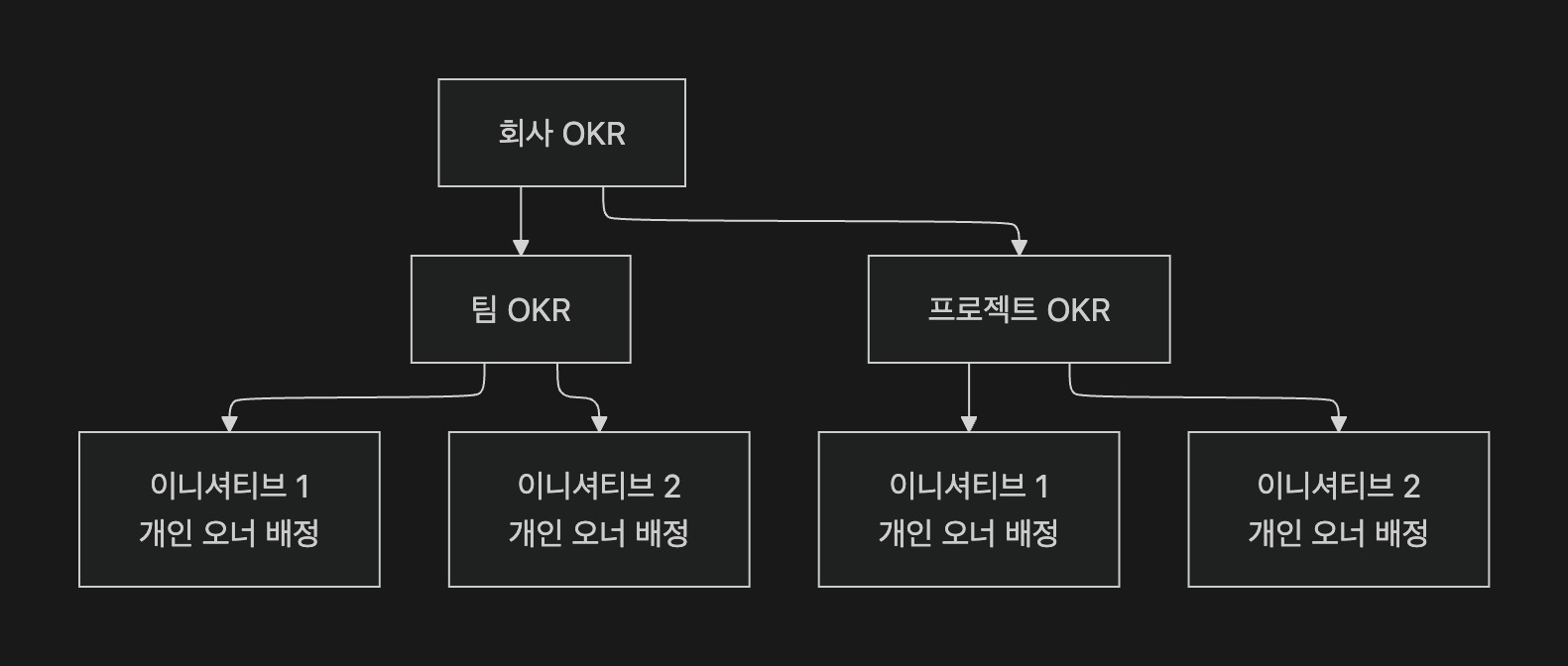
Instead of individuals “having” their own OKRs, they take ownership of initiatives under team OKRs — and that is the direction OKRs were originally intended for. Individual contributions become visible through the team’s KR achievement, while personal growth and evaluation are managed separately through one-on-ones and performance reviews.
OKRs are a tool for focusing an organization’s collective attention, not for precisely measuring individual performance. Keeping it simple, staying focused, and checking alignment quickly — that is the original value of OKRs. Confuse its purpose, and the market moves on without you.
#References
- How Google sets goals: OKRs — Rick Klau, GV Library (2013) The workshop was held in fall 2012; the YouTube video and blog post were published in May 2013
- Why individual OKRs don’t work for us — Spotify HR Blog (2016)
- Skip individual OKRs altogether — Rick Klau, Twitter (2017)
- Set goals with OKRs — Google re:Work
- What my OKRs video got wrong — Rick Klau (2022)